



Stainless Steel Welding Tables
Showing all 7 resultsSorted by popularity

Stainless Steel Welding Tables, Weld Tables
Stainless Steel Welding Table - 50" x 100"
Price range: $8,899.00 through $9,999.00
Select options
Stainless Steel Welding Tables, Weld Tables
Stainless Steel Welding Table - 50" x 50"
Price range: $4,799.00 through $4,999.00
Select options
Stainless Steel Welding Tables, Weld Tables
Stainless Steel Welding Table - 40" x 100"
Price range: $7,899.00 through $7,949.00
Select options
Stainless Steel Welding Tables, Weld Tables
Stainless Steel Welding Table - 40" x 80"
Price range: $6,399.00 through $6,499.00
Select options
Stainless Steel Welding Tables, Weld Tables
Stainless Steel Welding Table - 40" x 40"
Price range: $3,099.00 through $3,199.00
Select options
Stainless Steel Welding Tables, Weld Tables
Stainless Steel Welding Table - 30" x 60"
Price range: $3,499.00 through $3,599.00
Select optionsStainless Steel Welding Tables
Stainless Steel Welding Tables FAQ
Our stainless steel welding tables start at $3,099 for the 40×40 and go up to $9,999 for the 50×100 with casters. The price depends on the size you pick and your leg option (self-leveling feet, total lock casters, or both). These are more expensive than our carbon steel tables because 304 stainless is a premium material. But if you’re doing stainless or aluminum fabrication and can’t risk cross-contamination from mild steel, there’s no cheaper alternative on the market. We’re the only company making commercially available, US-built stainless steel welding tables.
Cross-contamination. If you’re welding stainless steel or aluminum parts, working on a carbon steel table can introduce iron particles into your weldment. That causes corrosion, discoloration, and can fail quality inspections. A 304 stainless surface eliminates that risk entirely.
Stainless also won’t rust, which is a plus if your shop has any moisture exposure. The trade-off is that stainless is non-magnetic, so you can’t use magnetic clamps or fixtures. All of our standard mechanical fixturing (clamps, stops, fab squares) still works perfectly since our holes are sized for 5/8″ / 16mm tooling on 2″ centers, same as our carbon steel line.
304 stainless steel. It’s the most common austenitic stainless grade and the right choice for a fabrication surface. It’s corrosion-resistant, easy to clean, and won’t contaminate your stainless or aluminum workpieces.
We get asked a lot if it’s OK to build 316 stainless parts on a 304 surface. The answer is yes. Both 304 and 316 are austenitic stainless steels, and sharing the same work surface is standard practice as long as you maintain it properly and don’t introduce carbon steel contamination.
We build seven sizes: 30×60, 30×80, 40×40, 40×80, 40×100, 50×50, and 50×100. That covers everything from a compact bench-size table for small parts work up to a full production surface. All tops are 1/4″ thick 304 stainless with 5/8″ holes on 2″ centers covering the entire surface, including the sidewalls. The standard working height is 38″ whether you’re using leveling feet or casters.
No. That’s the one trade-off with stainless. 304 stainless steel is non-magnetic, so magnetic clamps, squares, and fixtures won’t stick. All of our mechanical fixturing works fine though. Our holes are sized for standard 5/8″ / 16mm tooling on 2″ centers, so you can use any bolt-through clamps, stops, jigs, and fab squares. If you rely heavily on magnets in your current workflow, you’d want to stick with our carbon steel tables.
Exactly the same. 5/8″ holes on 2″ centers across the entire top surface and sidewalls. The stainless tables use the same designs as our carbon steel line, just built from 304 stainless. That means all of our standard accessories, extensions, vise mounts, and fab squares are compatible. The legs and cross braces also have the same laser-cut hole pattern for mounting accessories.
Depending on the size, you can choose self-leveling feet, total lock casters, or both (front casters, rear leveling feet). The leveling feet are rated at 1,800 lbs per foot. The casters are rated at 1,000 lbs per caster, with grease zerks for easy maintenance. The swivel casters lock in both the swivel and rolling directions.
The legs themselves are carbon steel tubing, powder coated black as standard. The powder coating creates a barrier between the carbon steel legs and the stainless top, so there’s no contamination risk. Standard working height is 38″ with either option.
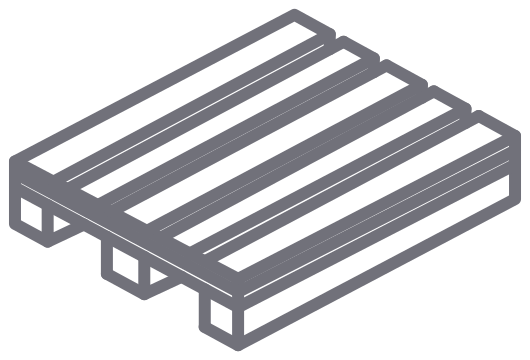
These ship fully assembled on custom-built pallets via freight. Each table is bolted directly to the pallet with heavy-duty hex head screws. Blue heat-shrink wrap protects the top surface during transit and doubles as a visual damage indicator.
For tables up to our 40×80 size, the shipping company’s pallet jack can usually reposition them on the truck. Larger tables need a forklift with at least 48″ forks on the receiving end. We recommend 72″ or 84″ fork extensions for the bigger sizes. If you don’t have a forklift, add our liftgate service to the order. Always inspect the table fully before signing the bill of lading.
Yes. 304 and 316 are both austenitic stainless steels. Sharing the same work surface is standard industry practice. The key is maintaining the table properly and keeping carbon steel tools, fixtures, and debris off the surface. As long as you’re not introducing carbon steel contamination, building 316 parts on a 304 table is perfectly fine and won’t cause issues with corrosion or material integrity.
Identical construction process. The same interlocking rib design, the same precision laser-cut components, the same build method where we bolt the top to a milled reference surface before welding the substructure. The only differences are the material (304 stainless instead of A572-50 carbon steel), the top thickness (1/4″ standard on stainless), and the fact that legs come powder coated as standard.
We use 142 bolts, 132 feet of threaded rod, 63 fixturing plates, and hundreds of weld points per table. At the end of the build, we verify flatness with a level across the surface. Same process, same team, same shop in Conroe, Texas.
Pros: It’s the best choice when welding stainless steel parts to prevent contamination. It offers superior rust and corrosion resistance, making it ideal for humid environments or industries with high hygiene standards (like food processing or medical).
Cons: The cost is the biggest drawback, often being 3 times as much as carbon steel. It has a slightly lower thermal conductivity than carbon steel. You can’t use magnetic tooling on stainless.
Explore More From Texas Metal Works

Weld Tables
Texas Metal Works is the largest US based welding table manufacturer. Our table tops are made from US processed steel,...

DIY Welding Tables

Heavy Duty Workbenches
Super heavy-duty steel workbenches built for industrial use. Featuring 3/8" steel tops and heavy-gauge tube frames, these metal workbenches handle...
Outfitting a Welding Lab?
We work with school districts, community colleges, and CTE programs across the country. Our tables are built in an ISO 9001 certified facility from A572-50 American steel, and we understand PO processes, bid requirements, and fiscal year timelines.
Need booths too? We build those as well. Same facility, same team, everything designed to work together.
ISO
9001 Certified
A572
American Steel
PO
Net-30 Terms
Free
Shipping Over $800